Why AI Sales Stall in Enterprise

In 2018 I led product and customer experience at a large US telco, and wanted to get our home internet accessories and smart home products listed on Google Shopping. Many competitors were already selling there, and I estimated the channel would add $3 to 5 million in revenue a year.
On paper this was the easiest deal in the company. Google was an established partner. We already had a long relationship with them and master service agreements in place, the umbrella contracts that are supposed to make every later deal a formality.
The deal went to legal, and legal asked for every old and current contract we had ever signed with Google. Those documents were scattered across a company with tens of thousands of employees, and nobody cared enough to find them.
Legal knew that when they asked.
I escalated, and nobody above me did anything about it. Five months later I gave up. As I write this in 2026, those products are still not listed on Google Shopping. Over six or seven years, at $3 to 5 million a year, that comes to somewhere between $20 and 35 million the company never earned, and nobody was ever asked to account for it.
That deal explains why AI startups struggle to sell into large enterprise better than anything I have read about AI. The vendor was Google. The relationship already existed. If credibility were the binding problem, it would have closed in a week.
Nobody gets paid to say yes
The usual story is that legal teams are slow. That lets everyone off the hook, because it makes the stall sound like a personality problem.
Look at it from the lawyer's desk. If legal approved the Google listing and something went wrong later, a pricing dispute or a brand problem, the approval would have their name on it. If the listing worked and made $10 million, the credit would go to me and my team. If they stalled, nothing would happen to them at all.
Revenue a company never earns does not show up on any report. There is no line in a legal department's review that says "deals we sat on." A bad approval can be traced back to a person. A deal that dies in a queue cannot.
So the request for every Google contract ever signed was a sensible move for the person making it. It looked like diligence, it cost them nothing, and it made the deal go away without anyone having to say no.
Everyone in a large company who can block a purchase is scored on what goes wrong. Nobody is scored on what never happens.
What AI adds
My deal involved one vendor, one channel, and one legal team. It was about as simple as enterprise deals get, and it still died.
An AI purchase brings more people with the power to block it. Security wants to know where the data goes. Privacy wants to know whether customer information trains someone else's model. Compliance asks which rules apply. In banks, a model risk team reviews anything that makes decisions. Some companies have added an AI ethics board on top of all that.
Each of those reviewers sits where the lawyers sat. They carry the blame if the system leaks data or makes a bad decision, and they get none of the credit if it saves money. Usually none of them has a deadline.
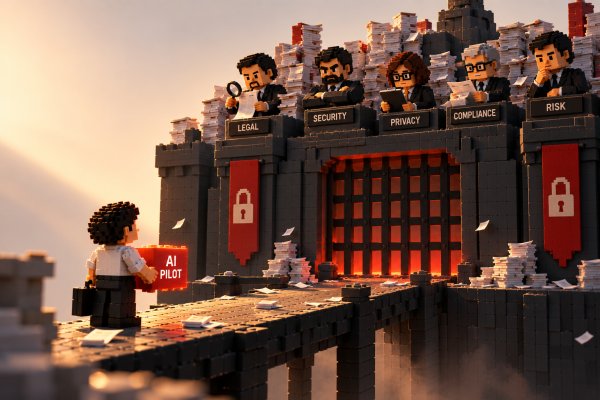
Founders tend to misread the stall as a credibility problem. They were too young, they came in cold, they needed a warm introduction from an investor. There is some truth in the access part. MIT's Project NANDA interviewed 52 organizations and surveyed 153 senior leaders for its 2025 report on enterprise AI, and many procurement leaders told the researchers they ignore most startup pitches. When those companies did find new AI vendors, the most common routes were existing vendor relationships, partner referrals, and peer recommendations.
Access gets you the meeting. It does not get you a yes. My deal had all the credibility a vendor could have, and it still died because nobody above legal owned the outcome.
What the 95% number actually says
The same MIT report produced the most repeated statistic in enterprise AI, that 95% of companies are getting zero return from generative AI. The number is usually quoted wrong.
The 95% comes from task-specific AI tools, the kind built for a particular workflow. About 20% of companies piloted one, and about 5% got one into production with a measurable result. That is a statement about pilots that never reached production. It does not say that 95% of AI spending lost money. The report is not peer reviewed and rests largely on interviews. Its authors call the figures directionally accurate, so they are best read as rough.
The report also lists a myth that legal, data, and risk concerns are what hold companies back. The researchers say they are not. They rank weak executive sponsorship and poor change management as the bigger barriers. Other surveys disagree. In a 2024 Salesforce survey of CIOs, security and privacy ranked as the top barrier. A worry that leaders state is not the same as the thing that actually killed a deal.
The MIT finding supports the argument once you see what my deal was missing. Legal was where the deal stopped. The cause was that no senior person owned the outcome. When I escalated, the people who could have set a deadline did not.
The report also measured how long rollouts take. Mid-market companies that succeeded moved from pilot to full rollout in about 90 days. Large enterprises took nine months or longer.
The manager whose team shrinks
There is one more person in the room who loses if the deal works, and they are often the person the vendor thinks is the buyer.
Much enterprise AI is sold, openly or quietly, as a way to do the same work with fewer people. The director who signs that deal is usually the person whose team gets smaller. In the large companies I have seen, a director's budget, title, and next promotion grow with the size of the team they run.
So the pitch asks that director to shrink their own department, take the risk of a failed rollout, and get nothing personal if it succeeds. A director who slows that deal down has read the offer correctly.
Sales training teaches reps to find the economic buyer, the person who controls the budget. In an AI deal, that person can easily be the one who has the most to lose from the purchase. A playbook built on finding them points the rep at the strongest opponent.
The people who run IT
Vendors usually assume the technology leaders are on their side. They can be the next place a deal stalls, for three reasons that have little to do with the technology.
The first is that sponsors move. An AI deal inside a large company often depends on one senior person who wants it, and large companies reorganize often. I have not found a study that counts how many deals die this way. The mechanism is simple. When that person changes roles, the deal loses its only advocate. Their replacement has no reason to finish a predecessor's project and every reason to start one of their own.
Chief information officers are fairly stable. Spencer Stuart's figures, as reported by The National CIO Review, put the average Fortune 500 CIO tenure at about 4.7 years. When the work sits with a chief data officer, the picture changes. An MIT Sloan Management Review article puts that role's average tenure at about two and a half years. A rollout that takes nine months or longer, on top of however long the contract took to sign, can outlast the person who started it.
The second reason is consultants. Many large companies hand their AI strategy to a consulting firm. Accenture booked $5.9 billion of generative AI work in its 2025 fiscal year. A consultancy is paid for the program: the assessment, the roadmap, the build, and the change management. A startup product that resolves customer tickets for $0.99 each makes much of that program unnecessary. I have not found a study that measures how often this steers vendor choices, so treat it as an argument from incentives. Nobody should expect a firm billing for a multi-year transformation to recommend the tool that shortens it.
The third reason is ego. In 1976 the psychologist Barry Staw ran an experiment in which business students made an investment decision that went badly. The students who had made the original decision themselves put more money back into it than students who had not. Later research on information systems projects by Mark Keil and colleagues, based on a survey of IT auditors, estimated that 30 to 40% of those projects show some degree of this escalation.
Microsoft's Copilot has given this pattern a lot of juice: A 2024 Gartner survey of 132 IT leaders found that only 6% had finished a pilot and planned a large rollout, 1% had deployed it across the organization, and 3% reported significant value.
A CIO who championed Copilot has little reason to look for a startup that does the job better, because buying it would mean admitting the first decision was wrong. "We already have Copilot" ends a lot of sales meetings, whether or not the company is using Copilot.
This has happened before
In 1990 the economist Paul David published a short paper on a puzzle from a century earlier. Thomas Edison opened his first central power station in New York in 1881. Electric motors were available, and they eventually proved better than the steam engines and leather belts that drove American factories. Yet factory electrification showed no effect on productivity until the early 1920s, about forty years later.
David's explanation was not that factory owners failed to see the potential. Their existing plants still worked, and replacing a working plant was expensive. It also took decades to learn that the real gain came from redesigning the whole factory around a small motor on each machine, instead of swapping one big motor in where the steam engine had been.
Both causes are present in enterprise AI. Companies have expensive systems and processes that still work, and many of them are bolting AI onto those processes instead of redesigning the work. The difference is that a 1900 factory owner made that decision alone. A 2026 company spreads it across several people who can each say no.
How the companies that close get around it
Three companies show different ways around the problem. Each either avoids needing all those yeses or removes a reason people have for saying no. None of them depends on the founder's age or who made the introduction.
The first route is to start with individual users. Cursor was founded by four MIT graduates in their early twenties. In its early period the company reportedly removed contact options from its website to discourage enterprise sales inquiries. Engineers adopted it on their own, and by early 2025 thousands of companies were asking for enterprise access to a tool their staff were already using. At that point the enterprise purchase was a decision to manage something already in place, which is a much easier decision for legal and security to approve.
The second route is to price on outcomes. Intercom charges $0.99 for each customer conversation its Fin AI agent resolves, and it has charged that price since launch. Sierra says publicly that it gets paid only when it completes a task. Outcome pricing helps in two ways. The buyer knows the cost of each result in advance, so there is less to argue about. And the buyer can point to a number that went straight into their own budget, which gives a sponsor something to take credit for.
The third route is to take the risk off the reviewers. In September 2023, Microsoft announced that it would defend paying customers of its Copilot products against copyright claims arising from the tools' output, as long as they used the built-in content filters, and pay any resulting judgments. Nobody has measured whether this shortened Microsoft's sales cycles. It was meant to remove one of the most obvious reasons a general counsel had to wait.
What investors are counting
The same problem shows up in the numbers investors use to value AI companies.
In March 2024, Jamin Ball, an investor at Altimeter, gave a name to a pattern in AI revenue. He called it experimental run-rate revenue, or ERR, and argued that a large share of AI revenue was experimental. Companies were paying for pilots and trials, and vendors were counting that money as if it were the annual recurring revenue of a normal software contract.
That revenue is fragile for the same reason my deal died. A pilot often has no owner who will be scored on its result and no budget line that survives the next planning cycle. When renewal comes, it faces the same reviewers and the same director who never wanted it.
An investor looking at an AI company's revenue could ask a simple question about each large customer. Who at that company is measured on the result this product produces? If the answer is nobody, that revenue is likely to stall at renewal the way my deal stalled in legal.
Where that leaves the sale
The usual question about a deal is who has the budget. The more useful one is who can block the deal, and what they gain from approving it.
For most reviewers the honest answer is nothing. The work is to give a senior person a result they will be measured on, and to take the risk off everyone else, before the deal reaches them.
The same question works when judging a customer that is already paying. My Google Shopping deal had a vendor everyone trusted, a contract already in place, and a clear revenue case. It still died, because nobody at the company had a reason to say yes and nobody had a deadline.
P.S. "Data readiness" is a sham - when has enterprise ever been data ready?
#EnterpriseSales #AIStartups #EnterpriseAI #VentureCapital
Originally published on LinkedIn, October 3, 2026.